
Dynamic Product Ads (DPA)
Scalable, personalized product advertising—designed for performance.
Role
Lead Interactive Designer
Timeline
2023-2024
Skills
User Research & Analyst
Usability Testing
Prototyping
Category
API Integrated Ads
The Problem
Advertisers struggled to efficiently promote large product catalogs with personalized messaging at scale. Static templates lacked flexibility, and manually creating variations was time-consuming and error-prone. The challenge was to design a scalable solution that automatically generated high-quality, relevant product ads while maintaining brand consistency.
Speaking to Users
We conducted interviews with seven digital marketers managing large-scale campaigns across the U.S. The research revealed that manual feed setup is time-consuming and error-prone, often delaying launches. Marketers emphasized the importance of clear, consistent product information to drive clicks and trust, especially when showcasing multiple SKUs dynamically. Finally, they needed tools to easily customize and preview geo-targeted ad variations, ensuring localized relevance without sacrificing brand consistency.
Persona

Ashley Jones
“I need dynamic ads that scale with my business—without turning feed management into a full-time job.”
Age - 29 years old
Occupation - Digital Marketing Manager
Backgrounds
Ashley manages large-scale e-commerce advertising campaigns across multiple U.S. regions. She works with product catalogs containing thousands of SKUs, frequent pricing updates, and localized promotions. Her day-to-day focus is on driving performance outcomes, not manual setup—yet she often finds herself pulled into feed validation, error fixing, and last-minute adjustments that slow down execution.
Goal
Ashley’s primary goal is to scale high-performing dynamic product ads efficiently while maintaining accuracy, consistency, and brand clarity across regions. She wants confidence that what launches is correct, localized, and optimized—so she can focus on strategy, testing,
and growth.
Behaviors
Ashley actively monitors performance metrics such as ROAS, CTR, and regional engagement to guide optimization decisions. She frequently iterates on campaigns, adjusts targeting and offers by market, and relies on tooling that allows her to preview, validate, and manage complexity without introducing risk or additional operational overhead.
Key Insights
An automated feed setup that reduces manual cleanup
Clean templates that display product details clearly
Simple tools to preview and manage geo-targeted ad variations
01. Product Feed
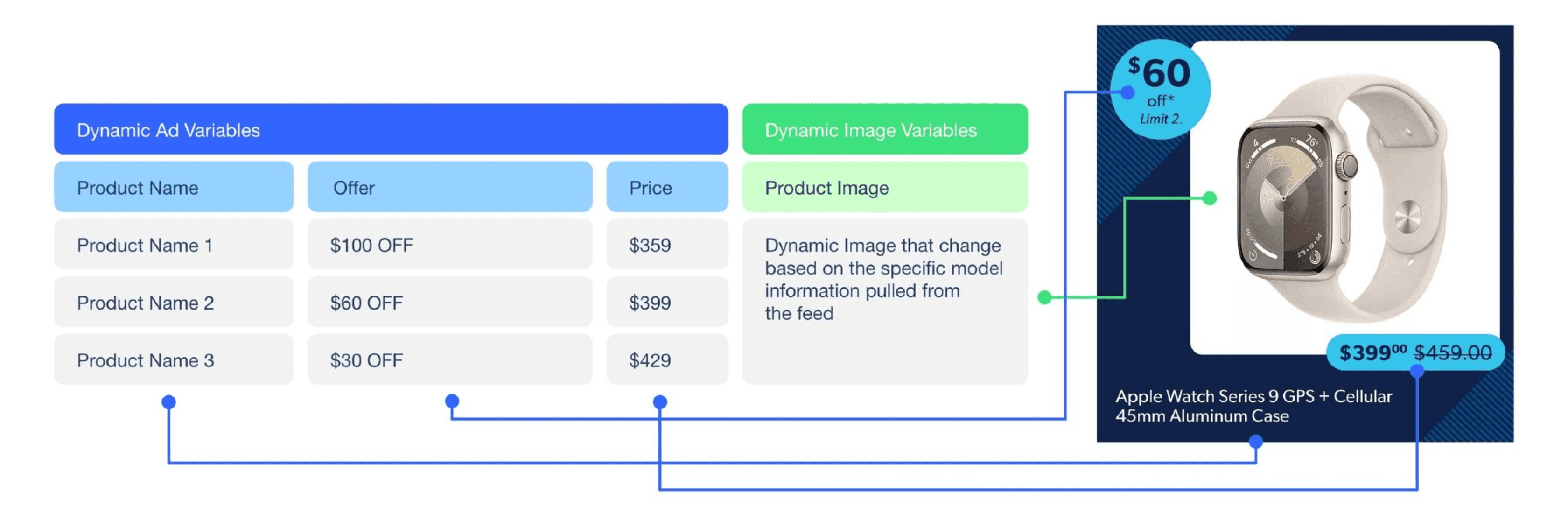
The product feed was structured to separate dynamic ad variables (text and pricing) and dynamic image variables to enable flexible, automated ad generation across product catalogs.
Design Decisions
This approach ensures the ad system is scalable, efficient, and easy to maintain, while delivering a consistent, high-quality experience for end users.
Structured Data Columns
The feed includes distinct fields for Product Name, Offer, Price, and Product Image, making it easy to map each attribute to specific visual elements in the ad template. This reduces manual setup and ensures consistent formatting.
Dynamic Image Integration
The design supports dynamic image slots that update automatically based on the product SKU. This enables accurate visual representation of each product without requiring separate creative assets for every variation.
Clear Offer and Pricing Display
Offers (e.g., “$60 OFF”) and current pricing are prominently surfaced in the layout, using distinct typographic treatments and contrasting backgrounds to highlight promotional messaging. This decision helps users quickly understand value and encourages engagement.
Real-Time Sync Compatibility
The feed structure was designed to support real-time syncing with inventory and pricing systems so ads always reflect the most current product data, reducing the risk of outdated information.
Scalable Mapping Logic
By aligning each data column to specific design modules (e.g., price badge, product title, callout bubble), the system can dynamically populate multiple product variations while maintaining a cohesive, branded look across all creatives.
02. Interactive Versions for Mobile and Desktop
To make large-scale product advertising feel effortless across devices, I designed templates that adapt seamlessly to both desktop and mobile.


On every screen, product images take center stage to immediately grab attention, while pricing and promotional offers are styled with high-contrast elements that communicate value at a glance. Each template follows a modular design system, where every component—image, product name, offer, and price—maps directly to dynamic feed variables. This lets even massive product catalogs populate automatically, eliminating the need for manual resizing or reformatting.
Consistency was key: colors, typography, and spacing are standardized so that campaigns feel cohesive, whether a user is browsing on a desktop or a phone. For mobile, I prioritized touch-friendly interactions, with larger tap targets and simplified layouts to reduce friction and boost engagement. And to support frequent updates, the templates flexibly handle different promotion types—from percentage discounts to limited-time offers—without requiring new creative assets.
The result is a system that balances scale, flexibility, and brand integrity, giving marketers the tools to deliver dynamic, personalized ads efficiently across all screens.
The result is a system that balances scale, flexibility, and brand integrity, giving marketers the tools to deliver dynamic, personalized ads efficiently across all screens. By using dynamic product feeds and automated templates, this project let marketers scale personalized, on-brand product ads effortlessly—bringing the same efficiency and consistency that Meta’s Advantage+ Shopping Campaigns aim to achieve.
03. Display Versions for Living Room Takeover
To extend the campaign’s reach beyond interactive screens, I designed display versions that preserve visual impact and brand presence across all placements. Even in non-interactive environments, the creative stays cohesive, maintaining the look and feel of the campaign while maximizing scalability. This approach not only broadens media reach but also improves efficiency, ensuring every ad remains visually compelling no matter where it appears.

Key Takeaways